The Secret of Selous Impala Camp -
Shy Masai
Giraffes, Yellow Baboon Troops, Exotic Birds and Animal Parades to the Watering
Hole
September
29-October 2 (days 1-3)


Selous
Camp is a magical and unpretentious place consisting of 8 tents on wooden
platforms, each with private balconies set in the bush on the side of the
Rufiji river, which is East Africa’s largest river. Each tent is solar powered and is guarded at
night by a Maasai warrior.

Our first night we experience a symphony of music which will be replayed in various melody iterations at our subsequent two safari camps. I wish I could transport these amazing sounds home. I imagine I am hearing the sounds of grunting hippos, babbling baboons, laughing hyenas and what I think are bird sounds but in truth I am too ignorant to be able to identify whether they could be a jackal or giraffe or waterbuck. Do you know the difference between a hippo and elephant sound? Barbara and Peter see a hippo sauntering in the bushes out front of their tent cabana near the river and this clarifies one of the sounds for them.

Our first night we experience a symphony of music which will be replayed in various melody iterations at our subsequent two safari camps. I wish I could transport these amazing sounds home. I imagine I am hearing the sounds of grunting hippos, babbling baboons, laughing hyenas and what I think are bird sounds but in truth I am too ignorant to be able to identify whether they could be a jackal or giraffe or waterbuck. Do you know the difference between a hippo and elephant sound? Barbara and Peter see a hippo sauntering in the bushes out front of their tent cabana near the river and this clarifies one of the sounds for them.

From our breakfast table we see a Giant
King Fisher and African Golden Weaver. Of course I don’t know these
names but our guides Festo and Dennis begin to educate us. We take 2 land
cruisers for our game drive down bumpy roads and our guides stop to look at
tracks in the dirt and to point out and describe the habits of an animal or
bird or insect.


I am amazed at the guide's ability to see these animals without binoculars or even regular glasses. We see a pregnant warthog that is quite ugly with a long black mane of hair, 2 sets of warts below the eyes, tusks from the mouth and a rather sexy trot gate somewhat like a small pony.


I wonder if these animals are as smart as a pig but struggle to want to photograph them. I wonder what is considered beautiful in the animal kingdom? The Kudu seems rather elegant with a velvet, bluish-grey, smooth coat and long hair down the center of its back and cut tail.


I am amazed at the guide's ability to see these animals without binoculars or even regular glasses. We see a pregnant warthog that is quite ugly with a long black mane of hair, 2 sets of warts below the eyes, tusks from the mouth and a rather sexy trot gate somewhat like a small pony.


I wonder if these animals are as smart as a pig but struggle to want to photograph them. I wonder what is considered beautiful in the animal kingdom? The Kudu seems rather elegant with a velvet, bluish-grey, smooth coat and long hair down the center of its back and cut tail.
 |
| Greater Kudu |
A tower
of Maasai giraffes


The world’s tallest animals reaching over 16 feet look
at us rather shyly with their gorgeous eyes and eyelashes. They seem to make
direct eye contact with us and I wonder what they are thinking.

The brown blotched coat color of the males tends to darken with age and we are told the head horns are covered with tuffs of hair for females but not for males. We learn they live 28 years and their pregnancies last 14 months but their next pregnancy will be 5 years later. Their baby is 5 feet tall at birth and must be at least 6.5 feet high to breast feed which is important because they aren’t able to eat leaves for 2-3 weeks. Our guide tells us they are not social animals and that the mothers will abandon their babies when predators are near. Sadly we are told 50% of giraffe babies die at birth or during infancy. The babies are dropped 5 feet on the ground at birth from the mother’s womb as she delivers standing. Festo says they are dropped because they need a “kick start” to live! They sound like very unloving mothers.. but we later learn from another guide this is not the case. In fact giraffes move away from their babies in order to divert predator’s attention and thereby protect them. Moreover due to their great height and excellent eyesight they have the capacity to keep monitoring their baby’s safety at a distance which is not true for most other animals. Since elephants have poor eyesight they would not use this strategy. Later I think that giraffe babies high death rate may also be due to water draught as well as predators. So I wonder if dry season has more deaths than wet season... this I must look up when I return.

The brown blotched coat color of the males tends to darken with age and we are told the head horns are covered with tuffs of hair for females but not for males. We learn they live 28 years and their pregnancies last 14 months but their next pregnancy will be 5 years later. Their baby is 5 feet tall at birth and must be at least 6.5 feet high to breast feed which is important because they aren’t able to eat leaves for 2-3 weeks. Our guide tells us they are not social animals and that the mothers will abandon their babies when predators are near. Sadly we are told 50% of giraffe babies die at birth or during infancy. The babies are dropped 5 feet on the ground at birth from the mother’s womb as she delivers standing. Festo says they are dropped because they need a “kick start” to live! They sound like very unloving mothers.. but we later learn from another guide this is not the case. In fact giraffes move away from their babies in order to divert predator’s attention and thereby protect them. Moreover due to their great height and excellent eyesight they have the capacity to keep monitoring their baby’s safety at a distance which is not true for most other animals. Since elephants have poor eyesight they would not use this strategy. Later I think that giraffe babies high death rate may also be due to water draught as well as predators. So I wonder if dry season has more deaths than wet season... this I must look up when I return.
Giraffes
browse the top of tree leaves with their lips and with their very long tongues
(18 inches) get some moisture from leaves. Unlike the camel they can’t store
water and need to drink 30-40 liters of water a day. I can’t imagine how difficult it must be to get their long necks down to drink water while standing! And how do they manage to have sex when they don't lie down?


Giraffes are “ruminants” and like antelopes and buffalos have a 4 compartment stomach which is a more efficient digestive system with about 230 ft of intestines; they only have to eat a few hours each day. When they eat the leaves go in the first stomach & later curds are brought back to the mouth for further chewing and then sent to the 2nd stomach to absorb the nutrients more quickly. This is in contrast to elephants who need to eat 18-19 hours a day because of their simple stomach and poor digestive system. Since elephants need to move 4 hours a day to get food, they are left with 1 hour per day for sleeping. On the other hand giraffes only sleep 20 minutes a day! I wonder if elephants and giraffes ever sit or lie down? Wow they must have good backs.


Giraffes are “ruminants” and like antelopes and buffalos have a 4 compartment stomach which is a more efficient digestive system with about 230 ft of intestines; they only have to eat a few hours each day. When they eat the leaves go in the first stomach & later curds are brought back to the mouth for further chewing and then sent to the 2nd stomach to absorb the nutrients more quickly. This is in contrast to elephants who need to eat 18-19 hours a day because of their simple stomach and poor digestive system. Since elephants need to move 4 hours a day to get food, they are left with 1 hour per day for sleeping. On the other hand giraffes only sleep 20 minutes a day! I wonder if elephants and giraffes ever sit or lie down? Wow they must have good backs.
Troop
of Yellow Baboons


There can be 20 to 70 baboons in one troop
with a large dominant male. We see them busy playing and foraging on the ground
picking out seeds and nutrients from elephant dung which is largely undigested
due to their inefficient digestive system. We continue to learn that what is
difficult for one animal can be beneficial for another. Indeed these animals
are interdependent and assist each other in the survival process. I am
fascinated by the baboons mutual grooming efforts which seem obsessive, and I
wonder if it has a purpose other than relationship building.


Often we see the baboons playing alongside the impalas in a symbiotic relationship. Baboons help protect impalas because from their tree heights they can warn impalas of approaching predators such as lions or jackals or hyenas. On the other hand, baboons eat baby Impalas. Either the impalas have a bad memory, or feel this sacrifice is worth the price they pay for the safety the baboons offer.


Often we see the baboons playing alongside the impalas in a symbiotic relationship. Baboons help protect impalas because from their tree heights they can warn impalas of approaching predators such as lions or jackals or hyenas. On the other hand, baboons eat baby Impalas. Either the impalas have a bad memory, or feel this sacrifice is worth the price they pay for the safety the baboons offer.
Incredible Birds


As we
travel our guide pauses to point out the many species of birds and I try to
capture them on my camera finding it difficult to keep the lens stable when
zooming in or to get the right depth of field or lighting. We even stop to watch matebele ants carry termites across the road.

John and Peter begin checking off bird sightings in their bird books. The spectacular lilac breasted roller happily models for me and waits so I can capture the lilac breast streaked with white and turquoise blue underparts.
This is East Africa’s
commonest roller & continually sparks the savannah trees at all our safari
camps. Later I find I have more than 50 shots of this bird & obsess over
which will be the best one. We also see Little Bee-eaters with their
metallic ultramarine blue eyebrows and red eyes. A Lessor Striped Swallow perches
on a Cassia tree with a yellow flower in bloom. I wonder if I was able to get a
focused shot.
No time to check or compose a picture as there is a smorgasbord
of potential pictures. I spot a rather dull colored black striped kingfisher
with grey-blue rump. I relate to this muted color - and the fact this
kingfisher eats insects not fish, is not flashy but is buff.

John and Peter begin checking off bird sightings in their bird books. The spectacular lilac breasted roller happily models for me and waits so I can capture the lilac breast streaked with white and turquoise blue underparts.
 |
| Lilac-Breasted Roller |
 |
| Acacia Tree |
Safari Schedule
At all
three of our safari camp sites our schedule is similar. We awake at 5:45 in the
morning and meet at the main lodge at 6:15 for coffee and a granola-like
biscuit. We must start when the weather is still cool. We drive searching for animals realizing that
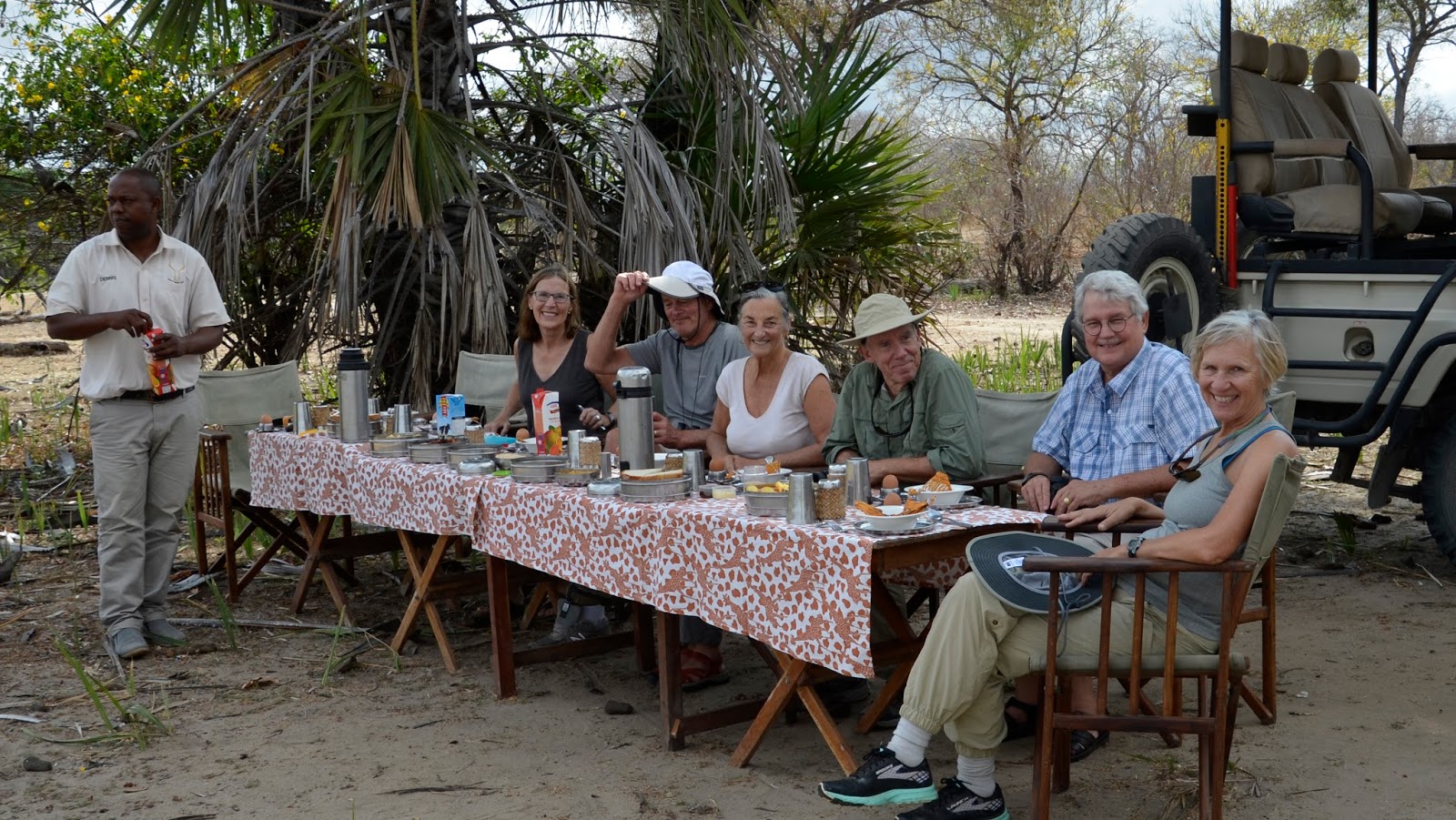
every drive offers unexpected findings and a new adventure. Around 9:30 we stop
at some amazing view spot for breakfast usually consisting of fruit, cereal,
eggs and often bacon. It is an English breakfast and I wonder what the
Tanzanian people would normally eat?

After breakfast we continue driving until 12:30 to 1 pm. By then the
heat is stupefying. I am sure it must be over 100 degrees. We are dripping wet,
zombie like and go back to our rooms for cold showers before lunch. After lunch,
naps are in order---there is little energy for anything else. Electricity to
all our safari camp sites is solar powered & the shower and tap water are
collected rain water or pumped from a nearby river. We drink bottled water.
This is the “yellow or dry season” that is approximately July to December. As
it is October we are at the end of the dry season and river beds are dry and
animals are searching for water river sites. There is 3 months of rainy or
green season from February to April. None of our camps are air conditioned, 2
of them have small pools and only 2 of them have fans! (Our 2nd Mwagusi safari camp has neither fans
nor a swimming pool).
 |
| Amazing Breakfast View |
 |
Our tent cabana at Selous  
View from deck of tent
|
At 4pm we
reassemble at the lodge for our evening safari either by vehicle or boat. We
stop around 6:30 for a sundowner drink by some amazing sunset spot, snapping pictures,
sharing and returning to the camp site around 7:30 for a delicious evening
meal. I find that being forced to be “off the internet grid” fosters more self-reflection and being "in the moment" in regard to what we are seeing, feeling and learning.
Parade to the Animal Watering Lake ~ A Staged Production


Our first
morning stopping to have breakfast was jaw dropping. We arrived at a table set
up near a lake which is chocked full with a deck of hippos, their babies and
crocodiles. I wonder if the crocs attack
the baby hippos? What is their
relationship like? At the end of the lake we see a single file of scores of
impalas coming to drink from the lake-- eventually, more than a hundred of them congregate.

The impalas leave when a herd of blue wildebeests, which are the most abundant big game species in East Africa, congregate to drink.


In turn the wildebeests leave in file when a dassel of zebras takes over the area. The zebras are smart letting the impalas and wildebeests to go first to assess potential danger from predators such as lions or leopards.


It is hard to know what to watch or take pictures of first.. the posing lilac-breasted roller, the


And then there are the two African Fish Eagles atop a tree watching all this choreography. It feels like we are the audience to a wonderful staged production, with different animals coming on and off the stage which is only 150 ft away. Sadly no leap of leopards, or pride of lions, or cheeky cheetahs, or any parade of elephants are in this play. All seems calm and serene and I think perhaps I am dreaming. And this is only the first morning! Yikes a lot to take in.
 |
| Impalas |

The impalas leave when a herd of blue wildebeests, which are the most abundant big game species in East Africa, congregate to drink.


In turn the wildebeests leave in file when a dassel of zebras takes over the area. The zebras are smart letting the impalas and wildebeests to go first to assess potential danger from predators such as lions or leopards.

 |
| A dazzle of zebras |
 |
| Baby zebras |
 |
| Wildebeests and Zebras coexist |

It is hard to know what to watch or take pictures of first.. the posing lilac-breasted roller, the
 |
| Yellow billed stork watches hippos ~ will he go in the water to get fish? |
 |
| Yellow billed Stork |


And then the hippos decide to move and show us their stuff! Are they loving? cute? will she or he step on the egret? I am not sure how to determine gender of these animals?


And then there are the two African Fish Eagles atop a tree watching all this choreography. It feels like we are the audience to a wonderful staged production, with different animals coming on and off the stage which is only 150 ft away. Sadly no leap of leopards, or pride of lions, or cheeky cheetahs, or any parade of elephants are in this play. All seems calm and serene and I think perhaps I am dreaming. And this is only the first morning! Yikes a lot to take in.


